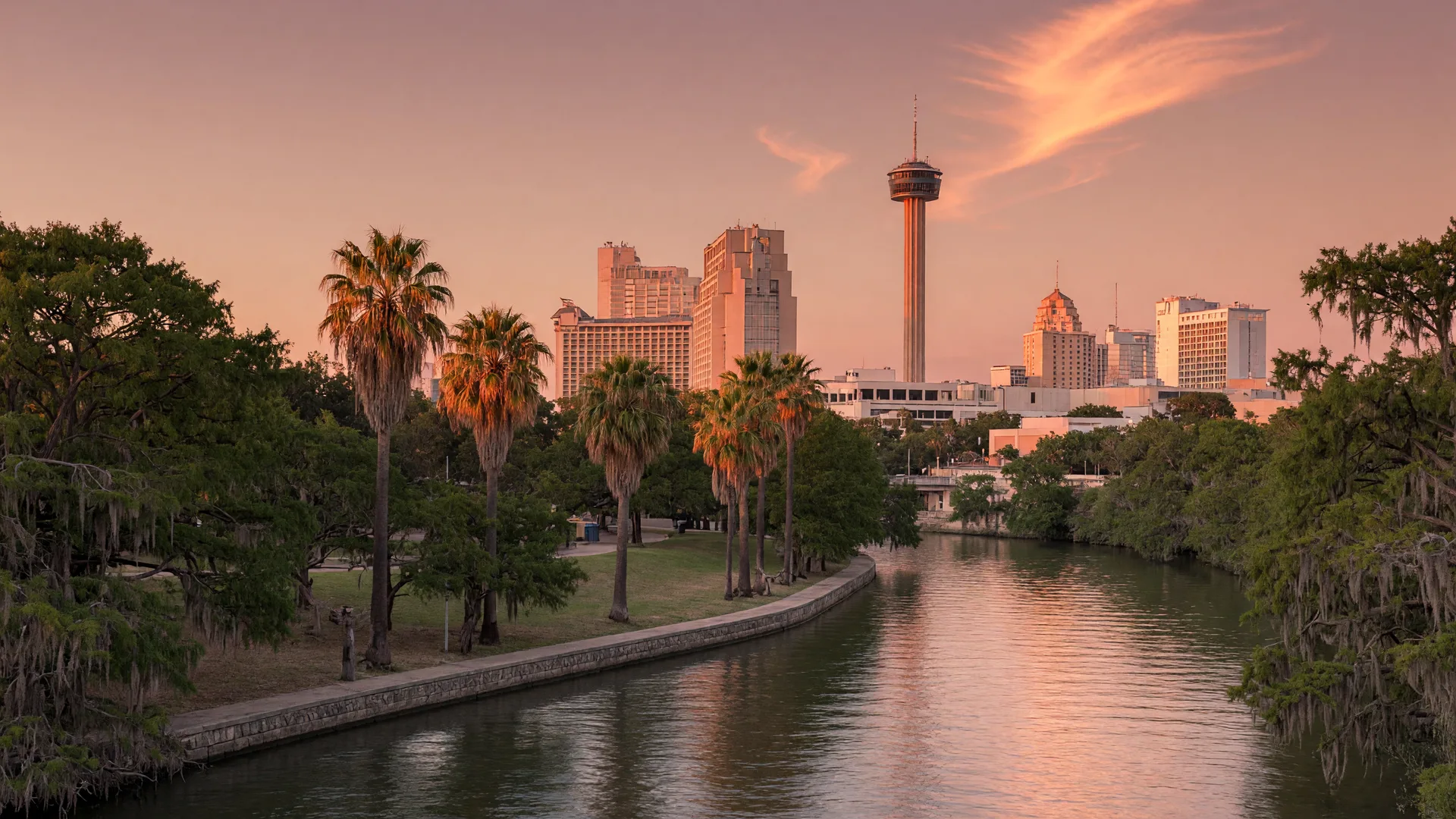
Living in San Antonio (2026): Relocation Guide
 By Phyllis Domingo, REALTOR® · San Antonio Relocation Specialist
More than 1.5 million people live in San Antonio, and the city added about 24,000 residents between 2023 and 2024, the fourth-largest population gain of any U.S. city.
Source: U.S. Census Bureau, Vintage 2024 population estimates (July 1, 2024), census.gov.
This is the 2026 relocation guide to San Antonio, written to be honest: what neighborhoods actually cost, how long the commutes really take, and how the schools work here. I'm Phyllis Domingo, a licensed Texas REALTOR® with more than 20 years of local knowledge across San Antonio, Boerne, and the surrounding Hill Country.
Neighborhoods
Most Searched Neighborhoods in San Antonio: Finding Your Right Fit
The ten most-searched areas below are the ones I talk about every week. The price bands come from 2025 market-tracker medians and should be read as a range, not a promise: medians swing by month and source, and the right number for you belongs to a specific home. Each neighborhood links to its full guide.
Stone Oak: roughly $450K to $650K+
What to Know
San Antonio's famous master-planned northside, a network of gated and open subdivisions built around the Loop 1604 and US 281 junction, with shopping, trails, pools, and parks woven through. It is suburban and drive-first: most errands are a ten-minute drive, and downtown is about 25 minutes typical, more at rush hour. It suits families who want new or newer homes, amenity-rich community life, and North East ISD schools. Late-2025 trackers put the median at roughly $487K to $545K, with smaller condos lower and large gated-section homes well above that.
Read the full Stone Oak guideAlamo Heights: roughly $650K to $1M+
What to Know
A two-square-mile city of its own about five miles north of downtown, known for a walkable village, bakery-lined shopping streets, and some of the most established in-town real estate in the region. Density is the tightest of the in-town suburbs, lots are small, and the downtown commute is about 10 minutes. It suits buyers trading square footage for location, walkability, and permanent in-town character, and it feeds Alamo Heights ISD. Late-2025 medians ran from about $694K (Redfin) to $850K (Movoto); it is a thin market, so monthly medians swing widely.
Read the full Alamo Heights guideTerrell Hills: roughly $800K to $1.2M+
What to Know
Alamo Heights' quieter, grander neighbor: the same 10-minute downtown commute and the same Alamo Heights ISD schools, but with larger lots, estate-scale homes, and park-like, low-traffic streets. Density is low and privacy is the point. It suits buyers who want in-town convenience without the village bustle, and who can step up to estate pricing. Twelve-month figures put the median near $845K overall and about $922K for single-family homes.
Read the full Terrell Hills guideKing William: roughly $425K to $1M+
What to Know
King William is San Antonio's original grand neighborhood, a National Historic Landmark district of restored Victorian, Italianate, and Greek Revival homes along the river bend south of downtown. It is dense, walkable, and urban: galleries and cafes at the doorstep, the river as the backyard, downtown about five minutes. It suits historic-home lovers and urban professionals who do not need a yard. Sales volume is low and medians are volatile, roughly $425K to $485K in early 2025, with listings running from fixers to multimillion-dollar estates.
Read the full King William guideAlamo Ranch: roughly $300K to $400K
What to Know
One of the region's biggest master-planned communities on the far northwest side (ZIP 78253), built around neighborhood pools, trails, and its own retail spine. It is suburban and family-focused, and the trade-off is distance: downtown runs 30 to 45 minutes at peak and Loop 1604 congestion is real. It suits value-conscious families who want newer construction and Northside ISD schools. Typical 2025 sales ran about $345K to $375K.
Helotes: roughly $425K to $550K
What to Know
Helotes hugs the northwest edge of the city with a small-town main street, an old-time festival calendar, and Hill Country views a few minutes past the retail strip. Density is low, lots are bigger in older sections, and the downtown commute runs about 30 minutes typical. It suits families who want a quieter Hill Country pace with Northside ISD schools and San Antonio jobs close by. 2025 medians sat around $463K to $467K.
Boerne: roughly $550K to $800K+
What to Know
The Hill Country town about 30 minutes northwest on I-10, with a walkable main street, Cibolo Creek greenways, a full festival calendar, and Boerne ISD's strong local reputation. Density is small-town: you drive for most errands, and the downtown commute runs 30 to 45 minutes at peak. It suits families who want small-town rhythm and Hill Country scenery while keeping a San Antonio job. The San Antonio Board of REALTORS reported medians above $600,000 through 2025, with other trackers from $635K to $675K.
Read the full Boerne guideFair Oaks Ranch: roughly $650K to $900K+
What to Know
Fair Oaks Ranch sits on the Kendall and Comal county line past Boerne, a largely gated community of golf, equestrian, and trail living with Boerne ISD schools and a roughly 30-minute downtown commute typical. It is the least dense of the city-adjacent options here, and it layers master HOA dues on top of neighborhood associations, so budget the fees. It suits buyers who want gated calm, views, and resort-style amenity, and who will pay for it. 2025 trackers ran from about $682K to $785K.
Read the full Fair Oaks Ranch guideBulverde: roughly $400K to $550K
What to Know
Bulverde is acreage country, a Hill Country village north on US 281 where many homes sit on half-acre to multi-acre, oak-shaded lots with Comal ISD schools and a roughly 30-minute downtown commute typical. Density is the lowest on this list and you drive for everything, which is exactly what many buyers want. It suits families who want space, privacy, and a slower pace while staying connected to San Antonio. 2025 medians clustered around $480K to $545K, with some reports lower.
Read the full Bulverde guideNew Braunfels: roughly $350K to $550K
What to Know
New Braunfels is the river town about 35 minutes northeast on I-35, with two rivers, deep German heritage, Gruene's dance halls, and a fast-growing Comal ISD. It is a real small city, denser and busier than Boerne or Bulverde, with its own job base. The downtown San Antonio commute runs about 35 to 45 minutes at peak. It suits families who want river recreation and a growing community at a reasonable midpoint between San Antonio and Austin. 2025 medians ran about $347K to $425K, with the 78132 side trending higher.
Read the full New Braunfels guideFrom me
Neighborhood Selection Tips from me
Twenty years in this market comes down to a short list of habits. These are the ones I wish every buyer used before opening a single listing.
The tip I give every family
Always confirm school assignment with the district directly, using the exact property address. Boundaries change, feeder patterns shift, and two houses on the same street can land in different schools.
- Run the commute twice before you commit: once in rush hour, once on a Saturday. The weekend drive lies to you.
- Budget the whole picture, not just the price. Property taxes, HOA dues, insurance, and the cost of the daily drive all change the math.
- Visit on a Tuesday morning and again on a Saturday afternoon. A neighborhood has two personalities, and you should like both.
- Match the block to your season of life. What serves a couple without kids rarely fits a family with school-age kids, and the honest fit changes over time.
- Let the house be the last decision, not the first. Choose the area, then the schools, then the street, and the right house shows up faster.
The honest picture
Honest Pros and Cons of Living in San Antonio (2026)
No place is a perfect fit for everyone. Here is what buyers should expect, good and bad, before they fall for a listing photo.
What to love
- Real housing value. The citywide median sits around $300,000 in recent Board of REALTORS data, far below Austin or Dallas, and Texas has no state income tax, which changes the monthly math.
- Big-city life at a small-city pace. The River Walk, the missions, the Pearl, pro sports, and a taco scene that is genuinely its own culture.
- A broad job base. Health care, the military, and major corporate employers anchor the market, and metro unemployment ran below the national average through most of 2025.
- Momentum. San Antonio keeps adding residents and building infrastructure, including the major Loop 1604 widening project.
What to expect
- Property taxes do the work other states leave to income tax. Bexar County's average effective rate runs near 1.73%, so research the exact bill for every property you consider.
- The heat is real. Summer highs run mid-90s, humidity is high, and the city averages about 18 days above 100°F a year. June through September is pool weather, not patio weather.
- You will drive. Most of the city is car-first: walkable pockets exist downtown, in Alamo Heights, King William, and Southtown, but the suburbs assume a car for everything.
- Peak traffic adds time. The citywide average commute is about 25 to 26 minutes, but the big corridors, I-10, I-35, 410, 281, and Loop 1604, stretch much longer at rush hour.
The daily drive
Commutes: Getting to the Main Employment Hubs
Most San Antonio jobs cluster around four areas: downtown, the Medical Center, the tech corridor along Loop 1604, and Joint Base San Antonio. These are typical one-way drives at rush hour, drawn from local commute guides and military PCS resources. The only honest test is your own route, at your own hour, twice.
Downtown San Antonio
10 to 45 minutes
In-town neighborhoods run 10 to 25 minutes. Far suburbs like Alamo Ranch or Boerne run 30 to 45 minutes at peak.
South Texas Medical Center
20 to 25 minutes typical
Stone Oak and the near-north neighborhoods are among the best commutes at about 20 to 25 minutes; Alamo Ranch and the Culebra corridor run about 20 to 25 minutes along Loop 1604.
The tech corridor along Loop 1604
5 to 25 minutes
The 1604 arc from UTSA and La Cantera through Stone Oak to the Tech Port area hosts much of the region's tech and corporate employment. North-side neighborhoods sit on it with 5 to 15 minute drives; Helotes and Alamo Ranch run 15 to 25 minutes along 1604.
JBSA Lackland
15 to 40 minutes
West-side neighborhoods like Alamo Ranch and the Highway 151 corridor are the sweet spot at 15 to 20 minutes; most of the city runs 20 to 40 minutes.
JBSA Fort Sam Houston
10 to 30 minutes
The near-north and Alamo Heights are closest at about 10 to 15 minutes; Stone Oak and Schertz run 25 to 30 minutes typical.
JBSA Randolph
10 to 35 minutes
Schertz, Cibolo, and Universal City are the neighborhood picks at 10 to 20 minutes; Stone Oak runs 25 to 35 minutes.
Schools
Schools: Verify Zoning for Your Exact Address
School assignments in Texas are street-specific. Your child's campus is decided by the district's attendance zone for the exact property address, and boundaries shift as districts grow, so the honest rule is simple: confirm with the district directly before you buy. No real estate site can guarantee what the district decides.
The right district is the one that fits your child's needs and your family's commute. Start with the guides below, then call the district with the exact address.
People also ask
Frequently Asked Questions About Living in San Antonio
Is San Antonio affordable?
Compared with Austin, Dallas, or the coasts, yes: the citywide median home price sits around $300,000, and Texas has no state income tax. The trade is property taxes, so the honest affordability number always includes the tax bill for the exact house.
What is the best suburb for families?
There is no single right answer, and the honest one depends on your priorities. Stone Oak wins for amenities and newer homes, Boerne for small-town Hill Country life, Schertz for military families near Randolph, and Alamo Heights for walkability in town. Match the suburb to your schools, commute, and weekend style rather than to a list.
How bad is traffic?
The citywide average commute is about 25 to 26 minutes, manageable by Texas standards. The caveat is corridors: I-10, I-35, 410, 281, and Loop 1604 back up at rush hour, and the 1604 and I-10 interchange is the region's worst bottleneck, so your specific commute matters more than the average.
What is the job market like?
Solid and broad. Health care is the metro's largest industry at about 14 percent of employment, Joint Base San Antonio anchors the military economy, and employers like USAA, H-E-B, Valero, Frost, and Toyota add depth. Metro unemployment ran roughly 3.7 to 4.1 percent through 2025, below the national average.
Is it hot year-round?
Not year-round, but summers are genuinely hot and humid: average July and August highs run about 94 to 96 degrees, and the city averages about 18 days above 100 degrees a year. Winters are mild, and spring and fall are the reward.
Where do military families live?
Roughly 80,000 active-duty service members call Bexar County home, and where they land usually follows the base. Near Fort Sam Houston: Alamo Heights, Terrell Hills, and Olmos Park. Near Lackland: Alamo Ranch and Helotes. Near Randolph: Schertz, Cibolo, and Universal City, with Stone Oak a popular all-around pick.
How walkable is San Antonio?
Honestly, most of the city is car-first. The walkable exceptions are real and wonderful: downtown, the Pearl, Southtown, King William, and the Alamo Heights village. If walking is a daily habit, pick one of those pockets; if not, pick the suburb that fits your commute.
Is San Antonio a good place to raise a family?
Yes, for most families: housing value, a broad school map, sports, parks, and a genuinely friendly small-town-in-a-big-city feel. The honest caveats are the heat, the car dependence, and the homework required to verify school zoning street by street.
Compare
How San Antonio Compares: Boerne, New Braunfels, and the Neighborhoods
San Antonio's surrounding towns are not cheaper suburbs; they are different trades. The head-to-head below is honest about where the trade-offs really are, and every neighborhood has a full guide with the same detail.
The next step
Ready to find your San Antonio? Let's talk.
Book a conversation with me and get honest answers about neighborhoods, schools, and prices, tailored to your family. No pressure, no jargon, just a local on your side.
Phyllis Domingo, REALTOR® Texas Sales Agent #745926 LPT Realty LLC